
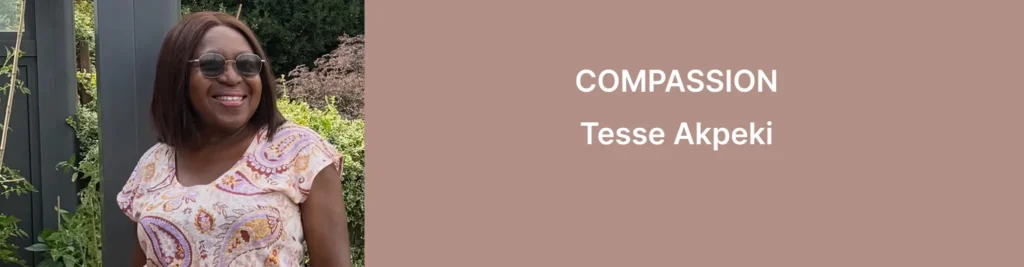
It’s often better and more compassionate to know when to build a bridge rather than a wall. We are all walking somewhere. Compassion means we walk side by side as we find our way home.
In this episode, Tesse Akpeki and Paula Okonneh talk about embracing all parts of ourselves- warts and all, including the beautiful attractive parts. We don’t deny and get defended about our shadow parts. All of us have a shadow. Integration makes us real, empathetic, loving and trusting.
In self-compassion we extend the same love to ourselves as we would a dear friend, gently, tenderly with acceptance and surrender.
With compassion we ask for help when we need it. We loosen our grip on the need to control everything. We become more vulnerable, authentic and transparent. We acknowledge the power of team work and how it makes the dream work.
Pulling on each other’s strengths and acknowledging area for further development, we celebrate ourselves and each other. This is a much better compassionate place and space to be.
Being compassionate does not mean we avoid responsibility. It does mean that we are more accountable to ourselves and others. We recognise the value of community, belonging and our collective capabilities.
Diana Ross says it all ‘reach out and touch somebody’s hand, make the world a better place if we can’.
Let’s know when to put the drawbridge down and identify the bridges we need to build.
00:00:00 Paula: Welcome to TesseTalks with your host, TesseAkpeki, who’s here, and I’m the co-host, Paula Okonne, where we share with you, our viewers and our listeners, top leadership and management strategies. This is, and continues to be, a journey of discovery, where we learn that leadership is personal and professional.
And we hope that you listeners, because this is an audio podcast, but we also sometimes take snippets from it and show you our videos behind the scenes many a times. So we hope you’ll, those of you who are viewing it and listening to it, we hope that you walk with us on this adventure. Today, I am speaking with my host, the main host, Tessie Akpeki, FGC and FAC.
She’s a lawyer. She’s a professional coach. 00:01:00 She’s a governance professional, a mentor, a researcher, a storyteller and a poet. And she is delighted to have received an invitation to join the Harvard Business Review Advisory Council, as well as to judge the Chartered Governance Institute for the United Kingdom and Republic of Ireland Awards.
There’s so much I can tell you about her. She has got an impressive bio!
00:01:40 Paula. Today, our topic, the theme is compassion. She and I are gonna just be having a conversation. So Tesse, welcome to your own show, Tesse Talks. This is interesting. I’m welcoming you 00:02:00 to your show.
How, how about that?
00:02:02 Tesse: I love it. We don’t do it often enough. But it’s nice to be with my favorite co-host and, and to be in the hot seat. I’m actually quite nervous but I’m looking forward to what questions you’ll ask me.
00:02:20 Paula: Well, you know, when Tesse says she’s nervous, I am shocked because Tesse, one thing about her is that she’s never short of words.
I call her, I call her my wordsmith. For every two words I speak, Tesse does 20.
00:02:42 Tesse: It’s true.
00:02:47 Paula: So when she says she’s nervous, I’m like, “Okay. All right. That’s interesting.” So anyway, this is about you and not to talk about how nervous you are. Let’s talk 00:03:00 about your life journey.
Describe your life journey . What’s your life journey? What has it been like?
00:03:17 Tesse: A potted version is that I was brought up in social care in Northern Ireland, and that was until the age of 10.
And then I went to West Africa, and I was there till I was, 26. So 16 years, in which time I went to secondary school – grammar school there, and I got two university degrees. I went to law school, and I practiced for five years. So that’s all that happened in those 16 years. So I came back to the UK.as a lawyer, after I had qualified and done five years post qualification, 00:04:00 and I had to start from the very bottom.
I had to start from the kitchen. I was a sandwich maker, I did three manual jobs and went to night school. And along the way, I qualified as a governance professional. I won awards from that. And I learnt how to touch type in those days. I was a junior civil servant, and actually rose to be a middle manager before working for a charity, a nonprofit, which I did for 13 years.
I started from the very bottom, which is a field officer, a development worker, and then I rose to become manager of the Trustee and Governance Unit in an organisation called the National Council for Voluntary Organizations. And after 13 years with NCVO, I became freelance. I was headhunted by a city firm, Bates Wells and I was with the city firm for another 00:05:00 14 years as a retained consultant.
So, you know, it’s been a varied life, but one of the things that has been very common about this life is actually starting from the grassroots and, and making my way through very low-paid jobs and, and, and now being, what I would say, strategist who is nationally and globally recognised. So it’s, it’s been a very varied life.
In many ways, I feel very grateful and privileged because I think it’s been a rich life as well.
00:05:35 Paula: Yes. You know. I always say to people, that people see, you see people and you don’t know their story. You see them many times at the… Somebody described it to me, “You’re seeing me in this chapter of my life or this chapter in my book.”
00:05:56 Tesse: Yeah.
00:05:56 Paula: You don’t know the chapters before that right. And that’s kind of what 00:06:00 you said, it’s been a very rich life. But as you said, those 16 years in West Africa, you went to secondary school and post-secondary school. You worked professionally for five years, and then came to the UK and had to start from the bottom.
00:06:18 Tesse: Yeah.
00:06:18 Paula: And those were some hard years, but. I always say no journey’s ever wasted. And, of course, that applies to each one of us. So can you talk about some of the highs within the lows? Because I know there have been some lows. I know when you start from the bottom, that’s the low. But within those lows, there had to have been some highs that I know are applicable to your life today, or am I wrong?
00:06:48 Tesse: No, you’re totally right, and I love the question because the way that I look at things these days, the perspective I hold, that there’s a gift in everything, even in those things which aren’t 00:07:00 easy. And one of the highlights for me was in the civil servant service where I was a very, very junior.
I was what they call then an admin officer, which is really quite junior. There was a guy there who was a senior executive officer, SEO at the time, and he saw me. He was very supportive of me until I left the civil service. And to just see that even in that very low where I was, he actually saw the potential in me, was very, very beautiful.
He used to give me some really, really good feedback. Even though he wasn’t my manager, he used to say to me, “You are really good, and I see it.” And it shows what becomes possible when people see you. I also remember when I won two awards from the Chartered Governance Institute, it was the ICSA then.
That gave me a boost, and I was able to get my next job because I got 00:08:00 those awards for company law and, and management and leadership. And then I got an overall award from the Charity Governance Institute charitable arm, which was, was very, very beautiful. And so those are the highlights.
But if you say to me what is actually brilliant for me is when people don’t look through you, you know, and they actually see your potential and they support you. Those made very, very lonely and isolated moments richer because a lot of people say, “Oh, you’re just a, you’re just an ordinary sandwich maker” .
It’s hard when you’re not seen and when you’re maltreated. So I think those moments, those pockets of kindness were absolutely brilliant. Absolutely brilliant. Could you imagine working three evening jobs and then going to night school? I mean, it’s kind of crazy. But somehow, 00:09:00 somewhere, I found the strength to do that
00:09:04 Paula: I, and you know, that reminds me of a story I heard recently about a young lady who had her – PhD. She was working on another PhD and, but couldn’t get a job.
And so she was working as a custodian. That is, like, cleaning toilets. She did that for four years until somebody saw her and asked, “What are you doing?” and took an interest in her. And he asked her a question, like, “Tell me about you.”
And she said, “Well, I’m a PhD student at Yale.” And his jaw dropped.
00:09:50 Tesse: Mm.
00:09:50 Paula: Sometimes at the right time someone sees you
00:10:11 Paula: And that matters. You know, as we go through life, we have different experiences, and we have different seasons in life.
Jesse brought out all his sons, and 00:11:00 Samuel kept saying, “No, that’s not, that’s not the one.” And Jesse said, “Oh, I have one that’s minding the sheep.” And when he came out Samuel said, “The Lord says this is the one.” And you and I said the Lord doesn’t look at the outward appearance.
Yeah. He looks at the heart.
Paula: We’ve all heard this story before, but it comes back again. It ties in with seeing beyond the exterior, seeing the person not. their position.
00:11:38 Tesse: Yes.
00:11:39 Paula: We are more than our jobs.
00:11:41 Tesse: Yeah.
00:11:41 Paula: We are people.
00:11:43 Tesse: Yeah. I love that. The person not the position. Absolutely beautiful.
00:11:50 Paula: The person and not the position. Yeah.
00:11:52 Tesse: Yeah. Yeah.
00:11:56 Paula: So what has kept you going, Tesse? 00:12:00
00:12:01 Tesse: That such a beautiful question as well. You know, finding meaning in what I’m doing, , finding a purpose in my life and, and more recent- recently it’s been looking for ways of turning my pain into my purpose and my purpose into my passion. You know, just having a reason to be here.
00:12:29 Tesse: People say to me is that they find me very encouraging.
00:12:37 Tesse: And they also say that they leave my presence much more buoyant and lifted than when they arrive.
00:12:50 Tesse: And that keeps me going because I have a kind of very philosophical, take on 00:13:00 life these days, which is if there’s something that I can do to make people’s life better, then it’s worth me being here.
00:13:13 Tesse: It’s a very, very different way of, of embracing life, really.
00:13:19 Paula: In other words, knowing that you’re unique. There’s no one like Tesse. I mean, there’s no one like each one of us. Knowing that we have a purpose.
00:13:31 Paula: There’s a uniqueness to each one of us.
00:13:34 Tesse: Everybody’s special.
00:13:42 Paula: Many times we have to remind ourselves of that.
00:13:45 Tesse: That’s where the compassion comes in.
00:13:49 Tesse: The compassion comes in because often we are accepting and loving and embracing of other people, 00:14:00 and often we are not the same friend to ourselves as we are to others, and self-compassion becomes alive when we recognise that we extend the same kindness to ourselves as we would to a friend that is dear to us.
And it’s not selfish. It’s actually self-full to, to have compassion on ourselves and then to embrace ourselves as we would others.
00:14:32 Paula: I love what you said, self-compassion is needed. We hear a lot about self-care, but I haven’t heard much about self-compassion, extending compassion to ourselves, because we tend to think of compassion as outward, not inward.
00:14:55 Paula: But we need that as well, inward compassion. We hear about 00:15:00 forgiving ourselves. Would you say it’s the same thing, Tesse, Self-forgiveness?
00:15:07 Tesse: Self-forgiveness is part of self-compassion.. Self-compassion covers so many different things. And you know, I love reading. There is a psychotherapist actually called Kristin Neff C. She has a whole piece on self-compassion.
Self-compassion would include forgiveness, self-forgiveness, but it will include self-care. It is an encouragement to embrace all the parts of us, ’cause we all, we all have shades. We have black and white, gray, different shades of us. And when we embrace all of us without guilt 00:16:00 or without shame. We do our best with ourselves and with others, at the same time we have shades of us, as shadows as well as, the good parts of us, we are able to be more authentic because we’re more holistic.
But what people sometimes do is to deny parts of themselves or defend parts of themselves. And so actually they’re not really showing themselves, showing up as whole people. And they get very defended. I know that no one’s perfect, so it’s actually for me there’s a motto I use that is progress not perfection.00:17:00
None of us is perfect. If I want to be the best version of me, the compassionate piece of me is to say, “This is where my strengths are. These are where my areas for development are. This is what I’m good at,” and to accept that there are parts that aren’t so good, and on a bad day I might turn up in a way that even I don’t like me.
And being compassionate is about the whole embrace of all the parts of me, being real.
00:17:34 Paula: I’m musing over what you said
00:17:38 Paula We get all bunged up with trying to be perfect, and that’s where self-doubt and self-hate thread comes in because you’re, you’re looking at somebody who’s imperfect, looking and seeing that they’re perfect.
Maybe they’re better at something than you are, forgetting that you’re better at something than they are, and you’re wanting to be them. And then you start disliking yourself. Meanwhile, you know, there’s that adage, the grass is always greener on the other side. You don’t know their weakness.
You don’t know what they’re struggling with, but you want to be them. And little do you know they’re wishing to be you, or they’re admiring you. Meanwhile, you’re spending all your energy wishing that you could be them.
00:18:43 Tesse: Yeah. Wow.
00:18:44 Tesse:, It’s very much about our mindset. A lot of the work that I do is around group dynamics and team dynamics and organisational health. We have the dark side of us 00:19:00 in the workplace, which can be about envy and jealousy. We can be very, very defended.
And actually, if we say to ourselves, “Look, there are parts of me where I excel, there are parts of me where, with the right support, I can be really, really good, and there are parts of me that I’m not so great at, and that’s okay. It just means that there are other people in the team or in the organisation that are better at it,” as you say, and we celebrate those people.
Part of compassion is actually to ask for help when you need it, to offer help if you can, but it’s also about knowing that teamwork makes the dream work. Oh, yes when you’re working as a team, pulling on each other’s strengths and encouraging each other, celebrating each other, it’s such a much more better place, but it’s also a very compassionate place .
00:19:59 Paula: 00:20:00 I absolutely agree. Oh, yes, teamwork makes the dream work. It’s something that I totally believe in because it really does. I mean, it’s so much smoother than trying to do everything yourself and getting frustrated.
That’s part of self-love, self-compassion, by delegating, saying, “I am so much better.” Like Tesse, you’re so much better with words. I would love if you could have been doing this interview instead of me.
00:20:36 Tesse: And I’d love being interviewed by you, I tell you.
00:20:40 Paula: Right, I’m looking at the time. We need to start wrapping up, but I know you love quotes And therefore, before we wrap up, what quotes can you leave with us today, Tesse?
00:20:53 Tesse: I’m going to leave you with one which is about walls and 00:21:00 bridges
00:21:05 Tesse: It’s often better and more compassionate to know when to build a bridge rather than to build a wall
00:21:16 Tesse: So let’s know those bridges that we need to build so that we walk hand in hand with those who are going home
00:21:25 Paula: I love it
Better to build bridges than to build walls. So let’s know when to build those bridges rather than walls so that we can walk hand in hand.
00:21:44 Tesse: As we find our way home, ’cause we’re all going home somewhere.
00:21:49 Paula: Oh, yes.
00:21:50 Tesse: So let’s walk towards home together.
00:21:54 Paula: Love it. Love it. Do you know who, who wrote that?
00:21:59 Tesse: I don’t know if 00:22:00 it’s written, but I’m just putting different thoughts together.
00:22:04 Paula: Right, that could be Tesse’s quote.
00:22:06 Tesse: Yeah. I’m just putting different things together.
There’s too much othering. There’s too much judgment. We’re human beings. Let’s be together-
00:22:18 Paula: Yes …
00:22:18 Tesse: with love and compassion.
00:22:22 Paula: Wow. So as we wrap this up and people are listening to this, this is TesseTalks, where can people who want to get in touch with you find you?
00:22:34 Tesse: The best place to find me is actually LinkedIn. The handle is @tesseakpeki. My personal blog is on Instagram at smileytesse_. And the easiest way also to get me is my website, and that’s tesse@tesseakpeki.com.
00:23:00 And you know, I’m always happy for people to connect with me. I love people.
00:23:05 Paula: You do. I can attest to that. I can definitely attest to that. And so I say to you, our amazing audience, thank you so much for tuning in. I ask that you head over to Apple Podcasts, YouTube, Spotify, or anywhere else that you listen to podcasts.
And if you haven’t done this already, please click subscribe. And if you like what you’ve just heard, who wouldn’t? Please write a raving review. If you have any questions or topics that you’d like us to cover related to governance or leadership, we’d ask that you send us a note. Remember, it can be personal as well as professional.
And if you’d like to be a guest on the show, please head over to our 00:24:00 website, which is tesseakpeki.com/TesseTalks to apply. Tesse, this sounds strange, I said it at the beginning and I’m saying it again, thank you for being a guest on your own podcast.
00:24:19 Tesse: Thank you for having me, Paula.
00:24:26 Paula: Don’t run out.
00:24:28 Tesse: I love, I love you. I really do. I’ve had fun with you today,